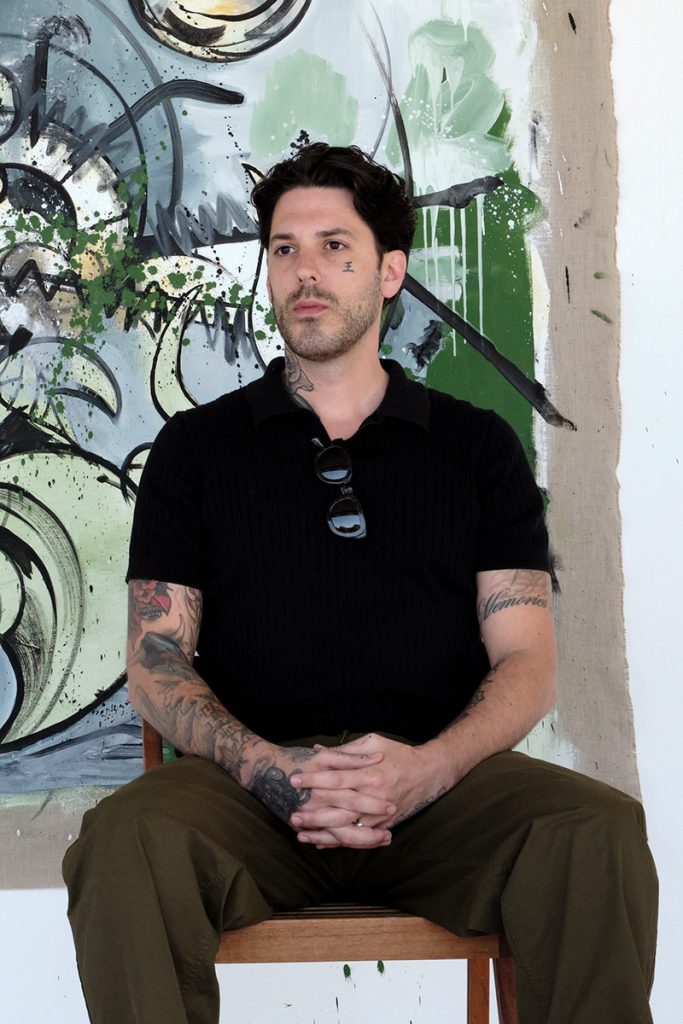
Alec DeMarco was born in 1989 in Cathlamet, Washington. His practice moves between drawing, painting, calligraphy and tattooing. It sits on the border between abstraction and figuration.
He grew up in a working-class community, far from the art world. His earliest creative memories are domestic. His grandmother would draw while watching Bob Ross on television. Then came the posters and graffiti on freight trains. It was his first real encounter with art. Yet he discovered his talent by chance, in a compulsory drawing class at university. Encouraged by a teacher, he sent a portfolio to art schools in the United States and Europe. Accepted by almost all of them, he then moved to California to study. There, for the first time, he visited a museum and a gallery. His curiosity soon extended to folk art and medieval illumination.
He first made illustrations for magazines and brochures. Yet he had to leave art school in his third year for financial reasons. He then turned to tattooing and committed himself entirely. For three years, he lived and learned every day alongside his Japanese master. He followed him wherever he traveled. He discovered brush calligraphy and Japanese mythology. It is full of deities, heroes and yōkai, the mischievous or benevolent spirits of folklore. The idea that every object might have a soul never left him. In his abstract shapes, an eye sometimes opens to look back at the viewer.
Alec DeMarco lives with aphantasia, the inability to form mental images. He therefore works from memory, drawing on impressions and sensations. Leaves, flowers and eyes become forms at once familiar and archetypal. He seeks to capture the feeling things evoke rather than their appearance. The eye, a recurring motif, is for him what reveals a person’s character and intentions.
Alec DeMarco follows a precise process. He first draws the lines in ink, then fills the spaces with color, “like a child coloring by numbers.” Yet he never tries to “finish” a work. Circular lines, fluid curves and movement have become the hallmarks of his language. He draws on folk art, graffiti, tattooing and color theory. His work also belongs to the lineage of CoBrA and Neo-Expressionism. He cites de Kooning, Guston, Basquiat and Picasso, but refuses to belong to any movement. For him, process matters more than outcome. The studio is thus above all a place of calm.
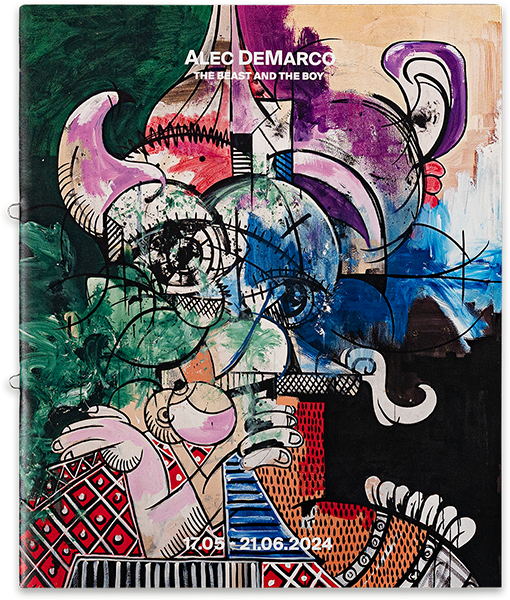
His work has been exhibited in the United States, the United Kingdom, Denmark, Germany and Qatar. In 2024, Galerie 75 Faubourg in Paris presented The Beast and the Boy. The exhibition was organized with Corridor Contemporary (Tel Aviv) and Galerie Enrico Navarra. It brought together works on canvas and paper made in 2022 and 2023.
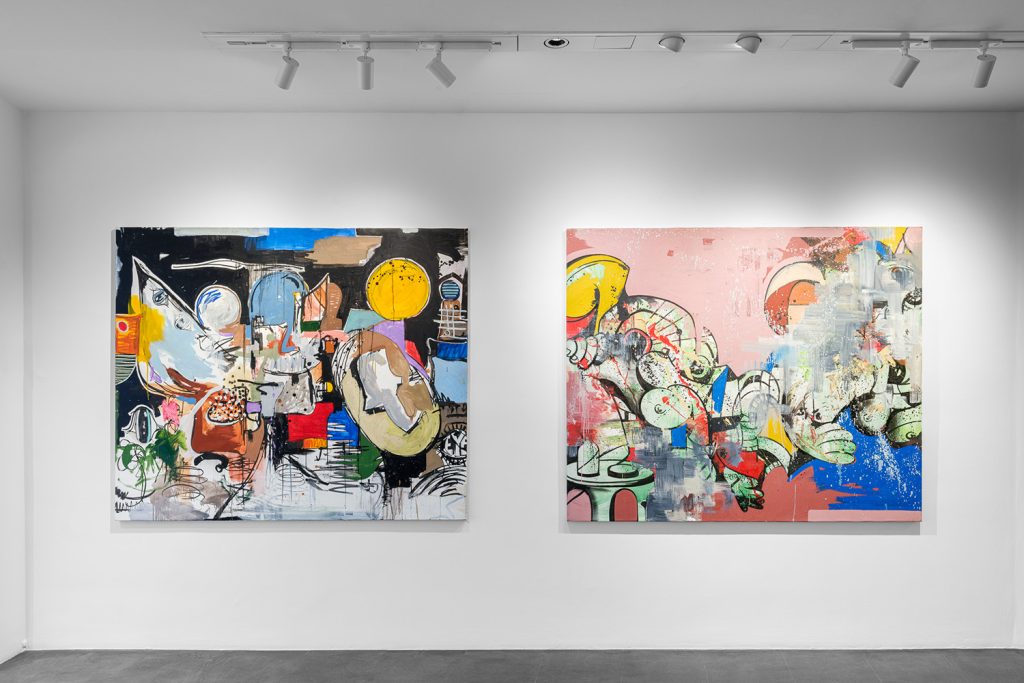
In collaboration with Corridor Contemporary (Tel Aviv) and the Galerie Enrico Navarra, we are presenting an exhibition by the American artist Alec DeMarco, featuring a selection of works on canvas and paper created between 2022 and 2023.
Sign up for our newsletter
Contact us
Publisher: Doriano Navarra
Site hosted by: Scaleway – Headquarters: 8 rue de la Ville l’Evêque, 75008 Paris
In accordance with Law No. 78-17 of January 6, 1978, known as «Data Protection and Civil Liberties,» you have the right to access, modify, rectify, and delete your personal data. You may exercise this right by submitting a simple request by mail to Galerie Enrico Navarra – 75, rue du Faubourg Saint-Honoré 75008 Paris – France or by email to presse@enriconavarra.com.
If you wish to ask us questions regarding our privacy policy or the use of your personal data, you can contact us at press@enriconavarra.com.
By browsing our site, you are informed and agree that your personal data may be collected on the site and used by it, which acts as data controller within the meaning of Regulation (EU) 2016/679 of the European Parliament and of the Council of 27 April 2016 on the protection of natural persons with regard to the processing of personal data and on the free movement of such data, and repealing Directive 95/46/EC (hereinafter referred to as the «General Data Protection Regulation» or «GDPR»).
We are committed to protecting and ensuring the security and confidentiality of your personal data in accordance with the GDPR, including by taking all necessary precautions to prevent this data from being distorted, damaged, or accessed by unauthorized third parties.
The elements present on this site (logos, texts, photos) are the exclusive property of Galerie Enrico Navarra. Any use, reproduction, or modification, even partial, of these elements without the agreement of Galerie Enrico Navarra is prohibited.
The information collected during your visit to the site is exclusively intended for internal use and will not be communicated to third parties for commercial purposes, except with your authorization.
This website uses Google Analytics, a web analytics service provided by Google, Inc. («Google»). Google Analytics uses cookies, which are text files placed on your computer, to help the website analyze how users use the site.
The data generated by cookies about your use of the site (including your IP address) will be transmitted and stored by Google on servers located in the United States. Google will use this information for the purpose of evaluating your use of the site, compiling reports on site activity for its editor, and providing other services relating to site activity and internet usage.
Google may share this data with third parties if legally required or if the third parties process this data on behalf of Google, including, but not limited to, the publisher of this site. Google will not associate your IP address with any other data held by Google.
You can disable the use of cookies by selecting the appropriate settings in your browser. However, doing so may prevent the use of certain features of this site. By using this website, you expressly consent to the processing of your personal data by Google under the conditions and for the purposes described above.